
What Does OOB Mean?
The Unclassified Version

35 years ago this month, I was terrified as I feverishly studied mountains of information so as to perform my Navy duties to the utmost of my ability.
But what was I studying that scared me so much?
Something called an “Order of Battle”.
(Note: All data in this article is derived from open sources and is just a small portion of the overall OOB)
An Order of Battle (OOB) is a comprehensive, hierarchical listing and analysis of a military force’s units, detailing their command structure, strength (personnel, equipment), location (disposition), capabilities (tactics, training, logistics), and organization, used by commanders for planning and understanding potential adversaries. It’s a dynamic tool showing how forces are arranged for a specific operation, campaign, or battle, moving beyond static tables of organization to reflect real-world combat situations.
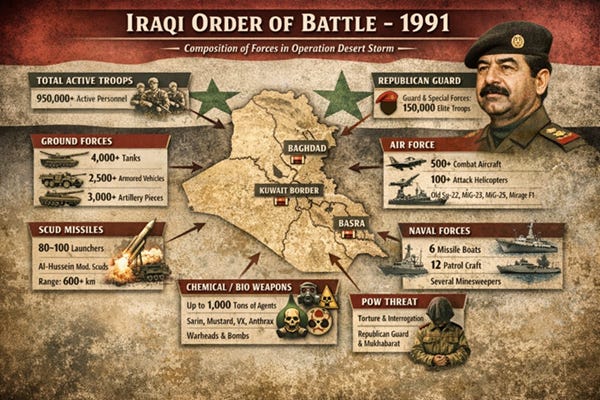
As the then-Aircrew Division Training Petty Officer for the frontline S-3 Viking Sensor Operators of VS-38, attached to the aircraft carrier USS Ranger,(CV-61) it was my duty to ensure that all 16 SENSOs were provided detailed Order of Battle briefings on the Iraqi military… as many and as often as possible.
But where does one start when you’re up against the 4th largest military in the world?
I figured that prioritizing threats to not only our Viking crews, but all other coalition aircraft and ground units in the Kuwaiti Theater of Operation during Operation Desert Storm was the best bet.
My training theory was, “Your fellow SENSOs deserve the dignity of being given every bit of intel and data on your enemies that the US Navy could possibly provide.”
They were all grown men, as well as highly motivated and elite operators who loved to know their subject matter. But this time, it wasn’t training. It was that life or death stuff.
The sheer volume of threats our Viking crews faced was really scary, if we indeed did have to go to war with Saddam Hussein’s Iraq.
Remember, this was more than 10 years prior to 9/11, and our military had not been in sustained combat operations since Vietnam.
As well, we flew in an aircraft originally designed to operate far out at sea hunting submarines. Not low and slow over massive city-block long oil platforms and adjacent to ground forces gun emplacements.

Are we talking Surface to Air Missiles systems (SAMs), including those shoulder-launched bad-boys? Oil rigs would be an ideal ambush site.
How about Anti-Aircraft Artillery (AAA)?
Chemical or Biological Weapons?
Iraqi Republican Guard torture and interrogation tactics?
Being taken POW was a real threat if shot down.
Exactly how does one decide which is the biggest threat to your teammates?
Instead of overwhelming the reader with the full Iraqi Order of Battle that is extremely long, I’ll just answer those few questions from above.
SAMs: Fixed & Vehicle-Mounted SAM Systems
SA-2 (S-75 “Guideline”)
Long-range, high-altitude
Fixed sites
Used for city and strategic asset defense
SA-3 (S-125 “Goa”)
Medium-range, low-to-medium altitude
Fixed sites
Backbone of urban air-defense rings (especially Baghdad)

SA-6 (2K12 “Gainful”)
Medium-range, mobile
Tracked launchers (TELs)
Most capable Iraqi SAM system in 1991
Primary battlefield and Republican Guard coverage
Roland (French/German)
Short-range, point defense
Vehicle-mounted
Deployed around regime, C2, and strategic sites
SA-8 (9K33 “Osa”) (limited numbers)
Short-range, mobile
All-in-one radar/launcher vehicle
Shoulder-Launched SAMs (MANPADS)

SA-7 Strela-2 (“Grail”)
First-generation IR, tail-chase only
Most numerous MANPADS in Iraqi inventory
SA-14 Strela-3
Improved IR seeker over SA-7
SA-16 Igla-1 (very limited)
More modern IR seeker
AAA: Self-Propelled / Radar-Directed AAA

ZSU-23-4 “Shilka”
Quad 23 mm cannons, radar-guided
Most capable Iraqi AAA system
Mobile; often paired with SAM sites and airfields
Dangerous to helicopters and low-altitude aircraft
Towed / Truck-Mounted AAA (Optical / Manual)
ZU-23-2
Twin 23 mm cannons
Widely dispersed; truck-mounted or emplaced
Simple, rugged, visually aimed
AZP S-60 (57 mm)
Medium-caliber towed AAA
Barrage fire against medium altitudes
Heavy Fixed AAA (Strategic / Legacy)
KS-19 (100 mm)
Heavy, fixed AAA with radar cueing
Emplaced around major cities and infrastructure
KS-12 / KS-30 (85–130 mm class) (limited / legacy)
Older heavy guns retained in static defenses
Light / Point-Defense Weapons (Supplementary)

12.7 mm DShK / 14.5 mm KPV
Heavy machine guns on tripods or vehicles
Used for point defense and harassment
Chemical/Biological Weapons: As of 15 January 1991, Iraq possessed a significant stockpile of chemical weapons, developed primarily during the Iran-Iraq War. These were not used during Operation Desert Storm, but deployments were made to forward positions in the Kuwait Theater of Operations, including missiles, artillery, and bunkers. The agents were often impure and stored in binary form (precursors mixed upon delivery) to extend shelf life. Estimates are based on post-war Iraqi declarations to UNSCOM and subsequent verifications, which reflect the pre-war inventory.

Just about 35 years ago this week, SENSOs from VS-38 practice donning their gas masks while standing next to a Viking aboard USS Ranger. We all knew that we would be some of the first casualties in the event that Saddam launched any chemical or biological weapons at us. Viking Aircrew were not issued a full MOPP protective gear loadout given their duties were performed while strapped to an ejection seat. If I remember correctly, we were issued a mask and injectable anecdotes
Chemical Weapons
Blister Agents:
Mustard gas (sulfur mustard): Approximately 500-600 tons remaining, from a total production of 2,850 tons (much consumed in the 1980s).
Lewisite: Limited quantities, produced as a mixture with mustard.
Nerve Agents:
Sarin (GB) and Cyclosarin (GF): Approximately 100-150 tons combined remaining, from a total production of 795 tons.
Tabun (GA): Approximately 100-150 tons remaining (included in G-agent totals), from a total production of 210 tons.
VX: 3.9 tons produced, with limited weaponization success due to purity issues (18-41%); estimates suggest up to 50-100 tons possible based on precursors.
Other: Phosgene (choking agent) in limited, early production.
Total bulk agent stockpile: Approximately 700-1,000 tons across all types, with UNSCOM later identifying up to 360 tons unaccounted for post-declarations.
Munitions and Delivery Systems
Iraq had weaponized these agents into various munitions, with a focus on tactical delivery. Many were stored in bunkers like those at Khamisiyah and Ar Rumaylah.
Total munitions: Approximately 40,000 (28,000 filled), with over 30,000 special munitions unaccounted for in later assessments; UNSCOM supervised destruction of 38,537 post-war.
Biological Weapons
Iraq’s biological weapons program was less mature than its chemical one but had achieved weaponization by 1991. Agents were produced at facilities like al-Hakam and tested in open air from 1988-1991. The program focused on incapacitating or lethal effects, with deployments to four sites in January 1991 (e.g., bombs and warheads). No use occurred during the war, and Iraq claimed unilateral destruction post-conflict, but UNSCOM suspected underreporting by 2-4 times.
Agents
Bacterial:
Anthrax (Bacillus anthracis): 8,400-8,500 liters.
Clostridium perfringens (gas gangrene): 3,400 liters.
Toxins:
Botulinum toxin: 19,000 liters.
Aflatoxin: 2,200 liters (carcinogenic, possibly for long-term effects).
Ricin: 10 liters.
Viral: Camel pox (possibly a simulant for smallpox); research into others like bubonic plague.
Simulants: Bacillus subtilis (for testing).
Munitions and Delivery Systems:
Aerial bombs:
Quantity: Over 16,000
(Approximately 19,500 total produced, many expended during the 1980s)
Details:
Free-fall bombs (e.g., 250 kg and 500 kg)
Filled with mustard gas or nerve agents
Three bombs later confirmed to contain VX
Artillery shells and rockets:
Quantity: Over 110,000
Includes ~54,000 artillery shells and ~27,000 rockets produced
Details:
122 mm rockets (e.g., 8.5 tons buried at Khamisiyah)
155 mm artillery shells
RPG-7 rounds
Binary designs for sarin/cyclosarin
500–700 mustard-filled shells unaccounted for
Ballistic missile warheads:
Quantity: 50–60
Details:
Al-Hussein (modified Scud) warheads
Some configured as binary nerve-agent warheads
Approximately 250 Ababil missiles with chemical warheads deployed in Kuwait
Other delivery and storage methods:
Quantity: Various
Details:
Chemical-filled land mines
55-gallon drums emplaced along borders
Multiple rocket launchers (e.g., 8 rounds per brigade)
Research and experimentation involving aerosols and drones

Iraqi Republican Guard Torture and Interrogation Tactics: (Pre-War Assessment)
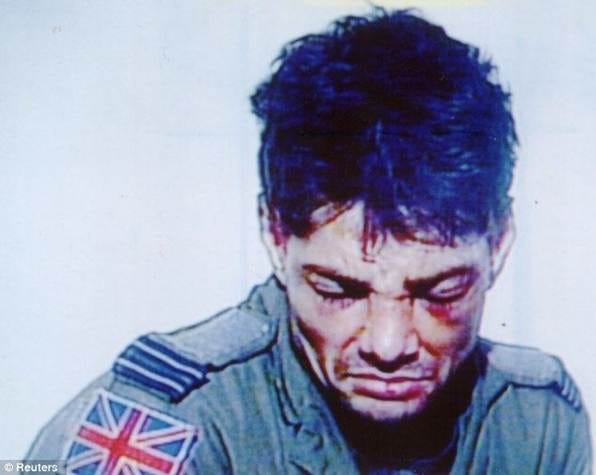
Image of British Flight Lieutenant John Peters while being held Prisoner of War by the Iraqi Republican Guard. https://en.wikipedia.org/wiki/John_Peters_(RAF_officer)
1. Immediate Capture Phase (Highest Volatility)
Anticipated risks:
Rough physical handling during capture
Beatings by local troops or guards
Threats of immediate execution
Public humiliation or parading
Why this was expected:
Iraqi forces had a reputation for discipline through fear
Initial contact likely involved poorly trained soldiers with little restraint
Chaos, anger, and revenge psychology were assumed
Training implication:
Survive the first hours; don’t escalate.
2. Early Interrogation Phase (Shock & Disorientation)
Anticipated techniques:
Physical coercion to establish dominance
Stress positions and forced posture
Sleep deprivation
Blindfolding and isolation
Purpose (as assessed):
Break resistance quickly
Establish total psychological control
Force rapid compliance—not accuracy
Key expectation:
Truth was not the goal—submission was.
3. Psychological Torture (Considered Highly Likely)
Coalition planners fully expected:
Mock executions
Threats against family members
Threats of handover to “worse” units
Forced witnessing of abuse of others
Sensory deprivation
Why this mattered more than physical pain:
Iraqi security doctrine emphasized fear and unpredictability
Psychological collapse was considered more valuable than physical injury
Aircrew briefing reality:
Expect lies, staged events, and deliberate terror.

Read about Saddam’s torture chambers here: https://www.institutkurde.org/info/saddam-s-house-of-horrors-1201099356
4. Medical Neglect as Leverage
Anticipated risks:
Denial or delay of medical care
Interrogation while injured
Use of untreated pain to coerce answers
Assessment before the war:
Iraq had no culture of POW medical ethics
Medical care would be conditional, not humanitarian
5. Sexualized or Identity-Targeted Abuse (Feared, Not Certain)
Anticipated but uncertain risks:
Sexual humiliation
Threats of sexual violence
Exploitation of cultural shame dynamics
Why it was included in risk planning:
Documented use by Iraqi security services against internal enemies
Known use of family dishonor as coercion
6. Propaganda Exploitation (Considered Near-Certain)
Anticipated tactics:
Filmed “confessions”
Forced statements condemning coalition actions
Appearances on Iraqi television
Why this was expected:
Saddam had used POW propaganda before
Strategic messaging value exceeded intelligence value
Aircrew guidance:
Say nothing useful; resist participation as long as possible.
7. Long-Term Detention Conditions
Anticipated environment:
Overcrowding
Poor sanitation
Malnutrition
Minimal Red Cross access initially
Purpose:
Slow erosion of morale and identity.
Last question: How does one prioritize such threats?
35 years later I’m still asking this same question.
And sadly, when I do, some Veterans complain that I need to “drop the subject and move-on with your life.”
It’s pretty hard to “move on” when you realize that you played a critical role in “the largest aerial assault campaign since World War 2.
That job required constantly analyzing the battlespace for threats. Every threat. And that level of threat analysis gets etched into your brain forever.
Making this even more surreal is the fact that 10 years after this event, I was sworn-in as an Honorary Member of the Pearl Harbor Survivors Association. Their oath concluded with the solemn duty to “Remember Pearl Harbor and Keep America Alert!”. (
(note: Upon telling me that I was nominated for to become an Honorary Member, that 85 year old Survivor told me, “and you have no say in the matter.”)
The following 12 years of work with the Survivors burned into me that their “duty to remember’ was just one aspect of that oath. The latter part of “Keep America Alert” is a solemn duty that cannot be fulfilled by “moving on” with your life.
Written by Dana “Hardball” Harbaugh, former AW Aircrew Division Training Petty Officer, VS-38 Fighting Red Griffins, Air Wing 2, USS Ranger (CV-61) and Life Honorary Member, Pearl Harbor Survivors Association.
Sources and References
Foundational Military Doctrine & Order of Battle
U.S. Department of Defense
Conduct of the Persian Gulf War: Final Report to Congress.
Washington, D.C., April 1992.
— Primary official synthesis covering Iraqi Order of Battle, air defenses, WMD assessments, and coalition planning assumptions.Defense Intelligence Agency (DIA)
Iraqi Military Capabilities and Order of Battle Assessments, 1990–1991.
Declassified summaries and excerpts.
— Baseline intelligence used by U.S. Navy and joint planners prior to Desert Storm.Gulf War Air Power Survey (GWAPS)
Volumes I–II. U.S. Government Printing Office, 1993.
— Definitive analysis of Iraqi SAM, AAA, air defense integration, and coalition SEAD effectiveness.
Iraqi Air Defense Systems (SAM & AAA)
Jane’s Land-Based Air Defence, editions 1988–1991.
— Technical specifications and deployment doctrine for SA-2, SA-3, SA-6, Roland, SA-8, and MANPADS.Anthony H. Cordesman
The Gulf War and the Air Power Debate. Praeger, 1996.
— Analysis of Iraqi air defense doctrine, system brittleness, and operational failure.Wikipedia (Technical Reference Pages)
Used for non-classified system descriptions only:SA-6 / 2K12 Kub
SA-7 Strela-2
ZSU-23-4 Shilka
— Cross-checked against Jane’s and GWAPS for consistency.
Chemical Weapons Program (CW)
United Nations Special Commission (UNSCOM)
Reports to the UN Security Council on Iraq’s Chemical Weapons Program, 1991–1998.
— Primary post-war verification of Iraqi CW agents, quantities, weaponization, and unresolved discrepancies.United Nations Monitoring, Verification and Inspection Commission (UNMOVIC)
Iraq Declarations and Inspection Findings, 1999–2003.
— Later reconciliation of CW stockpiles, precursors, and unaccounted munitions.Central Intelligence Agency (CIA)
Iraq’s Chemical Warfare Program: Status and Prospects.
Declassified assessments, early 1990s.Stockholm International Peace Research Institute (SIPRI)
The Problem of Chemical and Biological Warfare.
— Technical background on agents, binary weaponization, and storage challenges.
Biological Weapons Program (BW)
UNSCOM Biological Weapons Reports
— Findings on anthrax, botulinum toxin, aflatoxin, and delivery systems.CIA Declassified Assessments
Iraq’s BW Program: Capabilities and Intentions.
— Pre- and post-war intelligence evaluations.U.S. Senate Committee on Banking, Housing, and Urban Affairs
U.S. Dual-Use Exports to Iraq, 1994.
— Context for Iraq’s acquisition of biological research materials.
POW Treatment, Torture, and Interrogation (Pre-War Risk Context)
Amnesty International
Iraq: Evidence of Torture and Repression, late 1980s–early 1990s.
— Documentation of Iraqi security service practices prior to Desert Storm.Human Rights Watch
Endless Torment: The 1991 Uprisings in Iraq and Their Aftermath.
— Contextual evidence of Republican Guard and internal security brutality.International Committee of the Red Cross (ICRC)
Iraq and the Application of the Geneva Conventions.
— Baseline humanitarian law expectations and early POW access issues.Royal Air Force POW Accounts
John Peters (RAF) captivity documentation
— Used to corroborate anticipated pre-war POW risk assessments.
SERE & Aircrew Risk Doctrine (Unclassified)
U.S. Air Force & U.S. Navy SERE Doctrine
Unclassified portions.
— Basis for coalition aircrew expectations regarding capture, coercion, propaganda, and survival.
Historical & Contextual Works
Schwarzkopf, H. Norman
It Doesn’t Take a Hero. Bantam, 1992.Atkinson, Rick
Crusade: The Untold Story of the Persian Gulf War. Houghton Mifflin, 1993.U.S. National Archives (NARA)
Public-domain Gulf War imagery and operational records.
Methodological Note
All figures cited reflect open-source intelligence, declassified U.S. assessments, and UN verification data. Ranges are used intentionally to reflect known analytical uncertainty at the time of planning. This article prioritizes pre-war understanding, not post-hoc certainty, to accurately reflect the cognitive environment faced by operational aircrew and trainers.
Citation Philosophy
This article documents how threat reality was perceived before combat, not how it was reconstructed afterward. The purpose is to preserve the responsibility of decision-making under uncertainty, not to sanitize or sensationalize history.