
Their Duty to Remember:
A Rebellion Against Oblivion

Civilizations repeatedly rediscover that forgetting war makes future wars more likely.
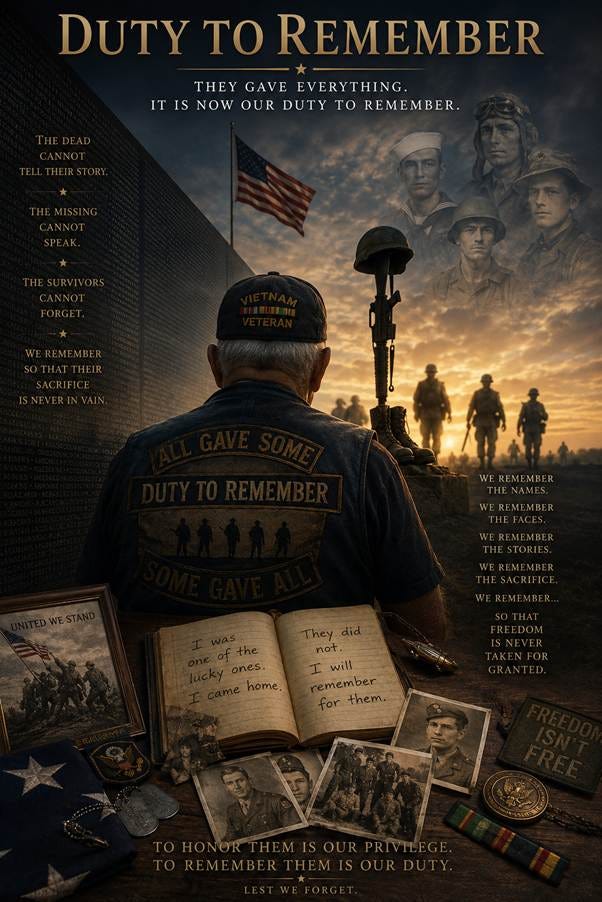
Throughout history, one of the oldest unwritten obligations placed upon warriors has been the duty to remember.
Not merely to remember battles.
Not merely to remember victories.
But to remember:
the dead,
the missing,
the sacrifice,
the suffering,
the lessons,
and the character of the men beside whom they stood.
This obligation appears across civilizations, religions, warrior castes, and military traditions stretching back thousands of years. Long before modern psychology or veteran organizations existed, societies understood something fundamental:
Warriors carry memory for the civilization that sent them.
And when they return home honorably, part of their burden becomes custodianship of remembrance.
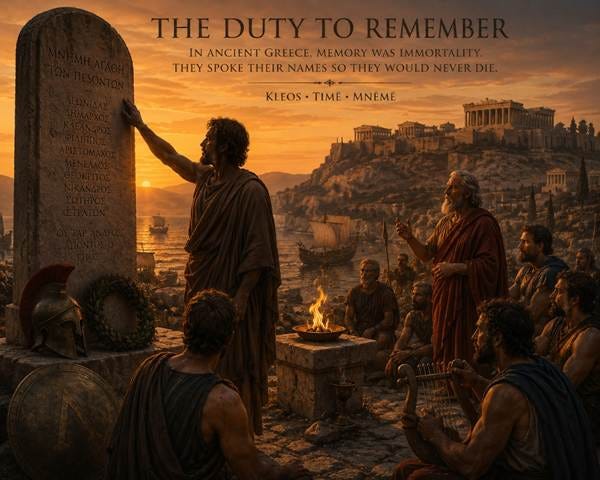
The Ancient Origins of the Duty
Greece — Memory as Immortality
In ancient Greece, warriors believed remembrance itself was a form of immortality.
The Greeks used the concept of kleos:
enduring glory,
fame carried through story,
memory passed through generations.
To die forgotten was tragic.
To be remembered honorably was transcendence.
This is why epic works like The Iliad were so culturally important:
they preserved the names and deeds of warriors long after death.
Warriors returning from battle became living custodians of memory.
The survivors carried:
names,
stories,
warnings,
and lessons.
Rome — The Republic Required Memory
In the Roman tradition, military remembrance became tied directly to civic duty.
Veterans of the Roman legions were expected to:
preserve unit honor,
commemorate fallen comrades,
maintain regimental identity,
and reinforce Roman virtues.
Military standards, memorial arches, inscriptions, and funeral rites were not merely symbolic.
They were mechanisms of collective memory.
Rome understood:
civilizations weaken when sacrifice is forgotten.
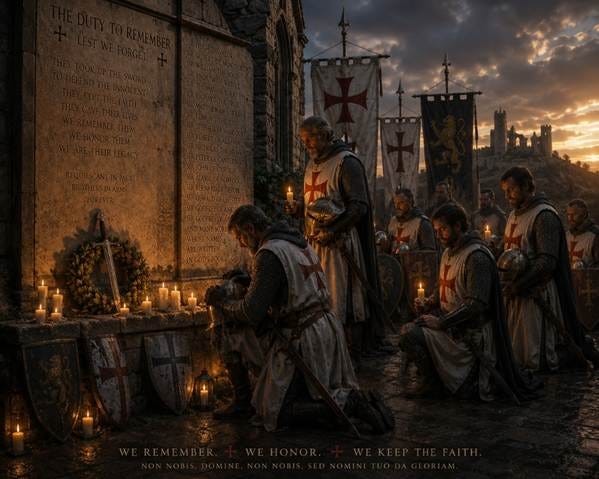
Medieval Warrior Cultures
Knights and Chivalric Orders
In medieval Europe, remembrance became intertwined with faith.
Knights were expected to:
honor fallen brothers,
maintain oaths,
care for widows and orphans,
and preserve martial lineage.
Monastic military orders like the:
Knights Templar,
Knights Hospitaller,
treated memory almost sacramentally.
The dead were prayed for continually.
Names were recorded permanently.
Banners and relics preserved lineage and sacrifice.
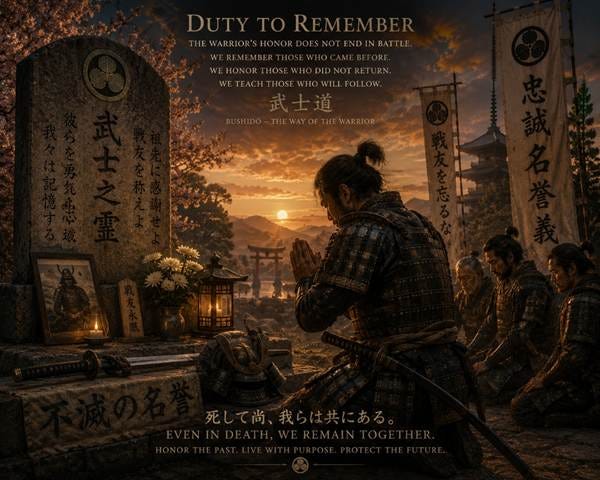
Samurai Tradition
In feudal Japan, the warrior’s memory duty became deeply ancestral.
The samurai concept of:
loyalty,
honor,
lineage,
and obligation to ancestors
created a culture where remembrance itself became moral continuity.
A warrior’s conduct reflected:
upon his ancestors,
his clan,
and future descendants.
To dishonor memory was to break continuity between generations.
Indigenous Warrior Traditions
Many Indigenous cultures across:
North America,
Africa,
Polynesia,
and Eurasia
maintained oral warrior traditions.
Veterans and elders became:
storytellers,
memory keepers,
and transmitters of tribal survival knowledge.
The warrior who survived battle often became responsible for teaching:
younger generations,
caution,
courage,
sacrifice,
and historical truth.
The survivor became a living archive.

The title of my book: Pearls of Honor: Their Duty to Remember (coming soon)
Why the Burden Falls on Survivors
This is the key principle across civilizations:
The dead cannot testify.
The survivors must.
That creates a moral transfer.
When honorable warriors return home, society unconsciously places several responsibilities upon them:
1. Witness
The veteran becomes evidence.
They saw:
what civilians did not,
what governments often sanitize,
and what history books later compress into abstractions.
The veteran therefore carries authenticity.
2. Custodianship of the Fallen
The living warrior becomes responsible for preserving:
names,
stories,
personalities,
humor,
fears,
and sacrifice of the dead.
This is why veterans often obsess over:
reunions,
memorial walls,
unit patches,
cruise books,
photographs,
gravestones,
and oral histories.
They are resisting erasure.
3. Preservation of Lessons
Civilizations repeatedly rediscover that forgetting war makes future wars more likely.
Veterans therefore often become:
instructors,
historians,
archivists,
mentors,
and public witnesses.
Not because they necessarily want to relive events —
but because memory itself becomes protective.
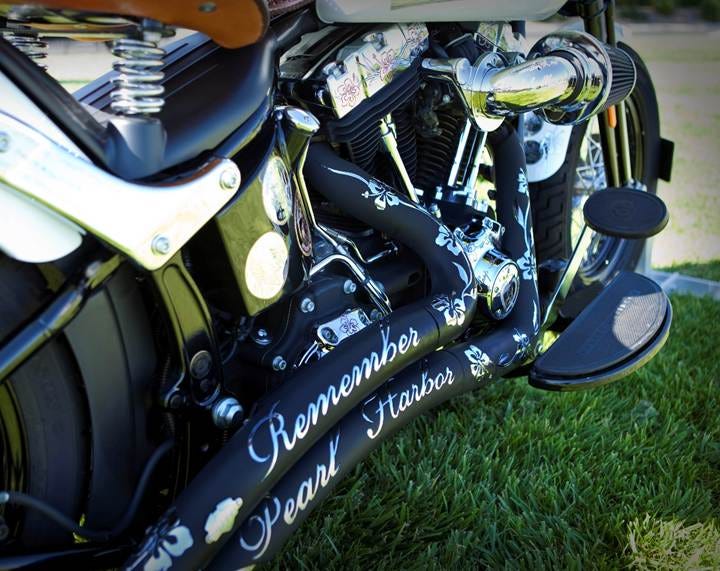
A Rolling History Lesson: Metal of Honor, the Remember Pearl Harbor Tribute Harley
The Modern American Tradition
The United States inherited this remembrance tradition from:
classical republicanism,
Christianity,
frontier militia culture,
and military custom.
This tradition appears in:
Memorial Day,
Arlington National Cemetery,
unit reunions,
battlefield preservation,
veterans organizations,
oral-history projects,
military museums,
and phrases like:
“Never Forget.”
After major wars, veterans often become the principal guardians of national memory.
Examples:
American Civil War veterans preserving regimental histories,
World War II veterans creating reunions and museums,
Vietnam War veterans building the Wall,
post-9/11 veterans preserving the memory of lost units and friends.

(Note: www.pearlsofhonor.com rebuilt website is under construction)
Why Honorably Discharged Veterans Feel This So Deeply
An honorable discharge is not merely administrative.
Historically, it represents:
completion of service,
trust fulfilled,
and reintegration into civilian society with retained honor.
But psychologically and culturally, many veterans discover something else:
The uniform comes off.
The obligation does not.
Especially among combat veterans or tightly bonded units.
The reason is simple:
Civilian society moves on rapidly.
Veterans often do not.
The men and women they lost remain psychologically present.
The missions remain vivid.
The memories remain active.
Thus many veterans feel compelled toward:
archives,
photographs,
memoirs,
podcasts,
reunions,
memorial rides,
museum donations,
historical preservation,
and storytelling.
Not merely from nostalgia.
But from perceived moral obligation.
The Fear Beneath the Duty
One fear appears repeatedly throughout warrior history:
That the sacrifice will be forgotten.
This fear is ancient.
Warriors across history have feared:
anonymous death,
historical distortion,
political abandonment,
and societal amnesia.
The duty to remember becomes a rebellion against oblivion.
Sources and References
The following historical, philosophical, military, literary, and cultural sources informed the themes, historical context, and conceptual framework behind Their Duty to Remember: A Rebellion Against Oblivion.
Classical Greece & the Warrior Tradition
The Iliad — attributed to Homer
The foundational Western epic exploring kleos (eternal glory through remembrance), sacrifice, mortality, honor, grief, and the preservation of warriors through story and memory.
The Odyssey — attributed to Homer
Examines the warrior’s difficult return home, memory, identity, and reintegration into society after prolonged conflict.
Histories — Herodotus
Among the earliest historical works preserving the memory of wars, civilizations, and fallen warriors through narrative testimony.
History of the Peloponnesian War — Thucydides
A seminal examination of war, memory, sacrifice, civic duty, and the moral burdens carried by combatants and nations.
Pericles’ Funeral Oration
Recorded by Thucydides, this speech remains one of history’s most influential expressions of collective remembrance and civic gratitude toward fallen warriors.
Roman Military Memory & Civic Duty
The Aeneid — Virgil
A Roman national epic emphasizing sacrifice, lineage, ancestral duty, and civilizational continuity.
Meditations — Marcus Aurelius
Stoic reflections on duty, mortality, service, discipline, and remembrance from a Roman emperor and military commander.
Roman Military Funerary Traditions
Studies of Roman military standards, triumphal arches, legionary burial customs, and memorial inscriptions informed the article’s discussion of remembrance as civic preservation.
Polybius and Livy
Classical historians whose works document Roman views regarding military honor, ancestral memory, and the preservation of collective sacrifice.
Medieval Knightly Orders & Chivalric Memory
Knights Templar
Historical studies of the Templars informed the article’s discussion of martial memory fused with religious duty and sacred obligation.
Knights Hospitaller
Research into monastic military orders contributed to the themes of brotherhood, sacrifice, and custodianship of the fallen.
The Code of Chivalry
Medieval European knightly traditions emphasizing:
honor,
loyalty,
remembrance,
protection of the weak,
and fidelity to oath and lineage.
“Non Nobis, Domine”
Derived from Book of Psalms 115:1:
“Not unto us, O Lord, not unto us, but unto Thy name give glory.”
Historically associated with crusader traditions and knightly humility.
Henry V
Modern cinematic representation of medieval warrior remembrance traditions following the Battle of Agincourt.
Samurai & Japanese Warrior Philosophy
Bushidō (“The Way of the Warrior”)
The ethical and philosophical framework of the samurai emphasizing:
honor,
loyalty,
memory,
ancestral continuity,
and sacrifice.
Hagakure — Yamamoto Tsunetomo
A major source regarding samurai duty, death, remembrance, and moral obligation.
The Book of Five Rings — Miyamoto Musashi
Influential Japanese martial philosophy touching upon discipline, continuity, and warrior identity.
Japanese Ancestor Veneration Traditions
Historical and cultural studies concerning ancestral reverence and continuity within samurai society informed portions of the article.
Indigenous & Oral Warrior Traditions
Indigenous Oral Histories
Research into Native American, Polynesian, African, and Eurasian oral traditions contributed to the article’s discussion of warriors as living archives and transmitters of survival memory.
Warrior-Elder Traditions
Anthropological studies examining how surviving warriors became teachers, storytellers, and custodians of tribal continuity.
Modern American Military Remembrance
Memorial Day
Historical origins and evolution of America’s principal national day of military remembrance.
Arlington National Cemetery
A central symbol of American military memory, sacrifice, and ceremonial remembrance.
American Civil War Veteran Reunions & Regimental Histories
Primary examples of veterans institutionalizing remembrance after national trauma.
World War II Oral Histories & Survivor Organizations
Sources include museum archives, veteran interviews, reunion organizations, and firsthand testimony projects.
Vietnam War & Vietnam Veterans Memorial
The Vietnam Veterans Memorial (“The Wall”) remains one of the most powerful modern symbols of collective military remembrance.
September 11 attacks & Post-9/11 Military Memory
Modern veteran memorialization efforts, unit remembrance pages, digital archives, and oral-history preservation projects informed the contemporary portions of this article.
Military Sociology, Psychology & Memory
On Killing — Dave Grossman
Analysis of combat psychology, memory, and the enduring psychological burden of warfare.
The Things They Carried — Tim O’Brien
Literary exploration of memory, survivor burden, grief, and storytelling among combat veterans.
Tribe — Sebastian Junger
Examines veteran identity, belonging, memory, and the difficulty of reintegration after combat service.
Oral History Methodology
Research from:
veteran museums,
military archives,
the Library of Congress Veterans History Project,
and university oral-history departments
helped shape the article’s emphasis on testimony and preservation.
Religious & Philosophical Foundations
Book of Psalms
Biblical foundations for humility, remembrance, sacrifice, and continuity across generations.
Stoicism
Greek and Roman Stoic philosophy regarding:
mortality,
service,
sacrifice,
and virtue under hardship.
Christian Memorial Traditions
Funerary liturgy, military chaplain traditions, battlefield crosses, and remembrance ceremonies informed the article’s moral and ceremonial themes.
Museums, Archives & Preservation
National Naval Aviation Museum
The article’s themes intersect directly with ongoing efforts to preserve naval aviation and warrior memory through archival donation and historical preservation.
Library of Congress Veterans History Project
A major national effort to preserve firsthand veteran testimony before living memory disappears.
Military Museums & Reunion Organizations
Various museum archival efforts and veteran reunions served as practical modern examples of “The Duty to Remember.”
Authorial & Project Context
Pearls of Honor: Their Duty to Remember
An ongoing photographic and historical preservation project by Dana “Hardball” Harbaugh documenting World War 2 veterans, particularly survivors of the Attack on Pearl Harbor, through photography, interviews, memorial events, and archival storytelling.
“Metal of Honor” — Remember Pearl Harbor Tribute Harley-Davidson
A rolling memorial project dedicated to preserving the memory and sacrifice of the Greatest Generation and America’s wartime veterans.
Suggested Further Reading
With the Old Breed — E. B. Sledge
Helmet for My Pillow — Robert Leckie
Band of Brothers — Stephen E. Ambrose
Citizen Soldiers — Stephen E. Ambrose
Ordinary Men — Christopher Browning
The Face of Battle — John Keegan
War and Peace — Leo Tolstoy
The Warrior Ethos — Steven Pressfield
Gates of Fire — Steven Pressfield
Once an Eagle — Anton Myrer
Fields of Fire — James Webb
Goodbye, Darkness — William Manchester
Closing Reflection
Civilizations survive not merely through victory in war, but through the preservation of memory afterward.
Weapons rust.
Empires fade.
Generations pass.
But remembrance — carried honorably by survivors — allows sacrifice to outlive mortality itself.
That is the warrior’s ancient rebellion against oblivion.
Another thoughtful piece.